
Information
Laboratory fume cupboards
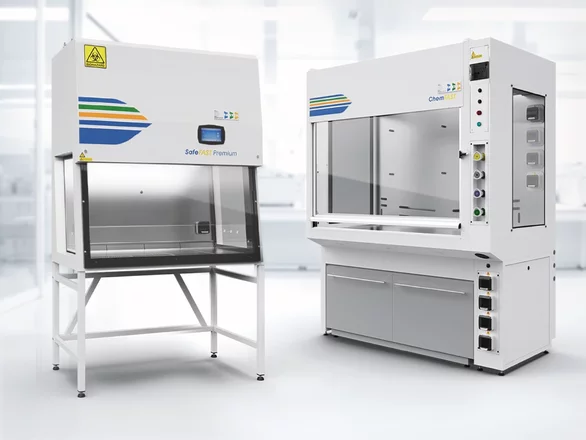
A laboratory fume cupboard (also known as a chemical fume cupboard, fume hood or digestor) is the key piece of safety equipment in science laboratories wherever work is carried out involving hazardous gases, vapours, dusts, aerosols or explosive substances. Pollutants generated are captured directly at the source by a continuous flow of air, purified via a filter system and safely removed from the work area. FASTER offers five specialised laboratory fume cupboards in its ChemFAST range, compliant with DIN EN 14175 – from the energy-saving hybrid model to the specialised spore and archive fume cupboard.
What is a laboratory fume cupboard – and when is its use mandatory?
A laboratory fume cupboard is a safety device with an open or sliding front panel. The interior is enclosed by a fire-resistant, chemical-resistant worktop and solid glass walls. A continuous airflow prevents hazardous substances from entering the user’s breathing zone. When the front panel is closed, the fume cupboard offers additional protection against splashes, glass breakage and uncontrolled reactions.
The requirement to use a fume cupboard is determined by the safety data sheet for the hazardous substance being used: if there is a risk of fire, gas or dust formation, the use of a certified fume cupboard is mandatory. Design and testing are regulated by DIN EN 14175; annual maintenance and testing are mandatory.
What is the difference between a laboratory fume cupboard and a biological safety cabinet?
Laboratory fume cupboards are designed for chemical vapours, gases and dusts – they filter or extract contaminated air, but do not offer protection against biological aerosols and microorganisms. Biological safety cabinets, on the other hand, provide protection against biological hazards through HEPA-filtered laminar airflow, but not against chemical gases. Anyone working with both types of hazardous substances requires both categories of equipment.
How does a laboratory fume cupboard work – exhaust, recirculation or hybrid?
The protective principle of a laboratory fume cupboard is based on a controlled air flow through the working opening. This so-called inflow (inflow velocity, typically 0.3–0.7 m/s) prevents vapours and aerosols from escaping from inside the fume cupboard into the room. Depending on the operating mode, there are three fundamentally different approaches:
What does 100% exhaust mode mean for a laboratory fume cupboard?
In pure exhaust air mode (Constant Air Volume, CAV, or Variable Air Volume, VAV), all contaminated air from inside the fume cupboard is discharged to the outside via a central exhaust system. This approach is suitable for all hazard classes and offers maximum safety – but requires a fixed exhaust connection. The ChemFAST Sharp (VAV, variable) and ChemFAST Classic (CAV, constant) operate on this principle. The Sharp automatically adjusts the airflow to the height of the sash, thereby saving energy; the Classic delivers a constant flow rate – ideal for reproducible processes.
What is hybrid technology in laboratory fume cupboards – and how does it save energy?
The FASTER hybrid technology in the ChemFAST Premium combines exhaust and recirculation modes in a single unit: 75 per cent of the filtered air is recirculated back into the workspace, whilst 25 per cent is discharged via the central exhaust system. This reduces energy consumption by up to 80 per cent compared with conventional exhaust fume cupboards. The fume cupboard requires only a significantly smaller exhaust connection – ideal for laboratories whose ventilation system does not provide sufficient exhaust capacity for all workstations. The filter combinations can be individually tailored to the substance classes.
FASTER offers the following laboratory fume cupboards
The FASTER ChemFAST range comprises five specialised laboratory fume cupboards, which differ in terms of air flow principle, energy efficiency, filter configuration and intended use. The following table provides a direct basis for decision-making:
| Feature | Premium | Sharp | Classic | Elite/Top | Archive |
|---|---|---|---|---|---|
| Air handling principle | Hybrid (75% recirculated air + 25% exhaust air) | 100% exhaust air VAV | 100% exhaust air KLV | 100% exhaust air VAV | 100% exhaust air |
| Energy saving | up to 80 % | high (variable) | medium (constant) | high (variable) | standard |
| Exhaust air system connection | partial (25%) | mandatory | mandatory | mandatory | mandatory |
| Airflow control | automatic (DC fan) | automatic (VAV) | manual (3 stages) | automatic (VAV) | manual |
| Inflow (m/s) | 0.12 | 0.3 / 0.5 / 0.7 | 0.3 / 0.5 / 0.7 | 0.3 / 0.5 / 0.7 | 0.3 / 0.5 / 0.7 |
| Filter modules (max.) | 3 | 2 | 2 | 2 | 2 |
| Special filters | HEPA+A/C+Special | all 9 types | all 9 types | all 9 types | Spores/Fungi Special |
| Widths (m) | 1.2 / 1.5 / 1.8 | 1.2–2.4 | 1.2–2.4 | 1.2–2.4 | 1.2–1.8 |
| Work surface | Ceramic, PP, stainless steel | PP, stainless steel | Ceramic, PP, stainless steel | PP, stainless steel | Ceramic, PP |
| Touchscreen / Display | Touch display | Multifunction display | Multifunction display | Multifunction display | Display |
| Standard | EN 14175 1–3 | EN 14175 3–6 | EN 14175 1–3 | EN 14175 3–6 | EN 14175 |
| Ideal for | Energy-saving laboratories without a full exhaust connection | Laboratories with frequently changing chemical compositions | Stable routine operation | Flexible large-scale laboratories | Spores, fungi, archived materials |
In which laboratory areas and sectors are laboratory fume cupboards used?
Laboratory fume cupboards are used wherever hazardous substances are handled – across all sectors:
- Analytical and instrumental chemistry: wet chemistry , acid-base reactions, digestion, distillation
- Pharmaceutical industry and galenics: active ingredient synthesis , formulation development, quality control
- Biotechnology and molecular biology: preparationof buffers and media, use of chemicals in biological processes
- Clinical diagnostics and pathology: formaldehydefixation , histological staining
- Food and cosmetics analysis: extraction , derivatisation, analysis of hazardous substances
- Electronics and semiconductor manufacturing: etching , cleaning with aggressive chemicals
- Petrochemicals and fine chemicals: Highly reactive substrates, organic synthesis
- Archives, restoration and mycology: spore and mould analysis, document restoration (ChemFAST Archive)
What standards apply to laboratory fume cupboards – and what maintenance obligations are there?
Laboratory fume cupboards in Europe are subject to a clearly defined framework of standards:
- DIN EN 14175 Parts 1–6: The authoritative European standard for laboratory fume cupboards. Parts 1–3 cover definitions, safety requirements and test procedures for exhaust air systems; Parts 3–6 additionally cover variable air volume control and specific test methods. All ChemFAST models comply with the relevant parts of the standard.
- EN 61010-1: Safety requirements for electrical measuring, control, regulation and laboratory equipment – applies to the electrical components of all ChemFAST fume cupboards.
- GefStoffV / TRGS 526: Technical Regulations for Hazardous Substances in the Laboratory. Mandates the use of tested fume cupboard systems for defined work involving hazardous substances.
- Operational Safety Ordinance (BetrSichV): Requires the regular testing of work equipment; for laboratory fume cupboards, at least one annual functional test by competent persons is mandatory.
Inspection requirement: Laboratory fume cupboards must be inspected for proper functioning before initial commissioning and at least once a year. Inspection results must be recorded. FASTER offers its own maintenance and inspection service.
Frequently asked questions about laboratory fume cupboards
What is the difference between a laboratory fume cupboard and a fume hood?
Laboratory fume cupboard, chemical fume cupboard, fume hood and digestor are synonyms for the same piece of equipment. In German-speaking laboratories, ‘laboratory fume cupboard’ is the most common term; ‘extractor hood’ is used more colloquially. All these terms refer to the same DIN EN 14175-certified safety device.
Can a laboratory fume cupboard be operated without an exhaust connection?
Yes – with the ChemFAST Premium (hybrid technology). This fume cupboard recirculates 75 per cent of the filtered air back into the workspace and requires only 25 per cent exhaust air. Normally, fume cupboards compliant with EN 14175 are not permitted for fully recirculating operation without any exhaust air connection – the ChemFAST Premium’s hybrid approach offers a practical, standards-compliant solution for laboratories with limited exhaust air capacity.
How often should a laboratory fume cupboard be inspected and serviced?
Before initial commissioning and at least once a year, this must be carried out by a competent person – as stipulated by DIN EN 14175 and the German Industrial Safety Regulation (BetrSichV). Test results must be recorded and retained. FASTER offers its own maintenance and testing service.
What sort of fume cupboard do I need for formaldehyde?
For formaldehyde applications, a laboratory fume cupboard fitted with a FORM filter (impregnated activated carbon) is required. All ChemFAST models can be fitted with this filter. Of particular note: the ChemFAST Archiv is specifically designed for working with spores, fungi and biological substances – it is also suitable for pathological and histological fixation work using formaldehyde.
What do VAV and KLV/CAV mean in the context of laboratory fume cupboards?
VAV (Variable Air Volume) refers to a variable air volume: the exhaust air flow rate is automatically adjusted to the position of the front window – when the window is closed, less air is extracted, which saves energy. KLV/CAV (Constant Air Volume) means a constant air flow: the exhaust air flow remains constant regardless of the window position. VAV models (ChemFAST Sharp, Elite/Top) are more energy-efficient; KLV models (ChemFAST Classic) offer more stable working conditions.
