
Information
Hazardous substances / CMR substances
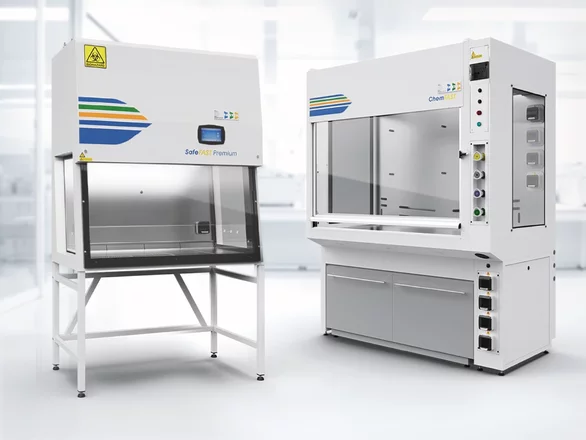
CMR substances (carcinogenic, mutagenic, toxic to reproduction) are among the most hazardous substances encountered in day-to-day laboratory work. Unlike acutely toxic substances, CMR substances often exert their harmful effects with a delay, cumulatively, or even following minimal exposure – which makes regular monitoring and well-planned technical protective measures essential. The Hazardous Substances Ordinance (GefStoffV), in conjunction with the TRGS regulations, sets out strict obligations for the handling of CMR substances: from risk assessment and substitution testing to the provision of certified fume cupboards, safety workbenches and isolators. FASTER , as a full-range supplier, offers the right equipment for every CMR risk class – from volatile chemicals in laboratory fume cupboards to highly potent active substances in sealed isolators.
What are CMR substances – and how are they classified?
The term ‘CMR substances’ encompasses three classes of harmful effects, which are classified in accordance with the EU CLP Regulation (EC) No 1272/2008 on the basis of the Globally Harmonised System (GHS). Each class is further subdivided into categories that reflect the level of scientific evidence:
| CMR category (CLP) | Meaning | GHS classification | Labelling | Examples |
|---|---|---|---|---|
| Category 1A | Proven to be carcinogenic to humans | Carcinogen Cat. 1A | GHS08 + H350 | Benzene, asbestos, formaldehyde |
| Category 1B | Proven to be carcinogenic (animal studies, extrapolated to humans) | Carcinogen Cat. 1B | GHS08 + H350 | Benzo[a]pyrene, nickel compounds |
| Category 2 | Suspected of having carcinogenic effects | Carcinogen Cat. 2 | GHS08 + H351 | Chloroform, styrene |
| Category 1A/1B (Mut.) | Proven to be mutagenic | Mutagen Cat. 1A/1B | GHS08 + H340 | Ethylene oxide, cyclophosphamide |
| Category 1A/1B (Rep.) | Proven to be toxic to reproduction | Rep. Cat. 1A/1B | GHS08 + H360 | Thalidomide, lead compounds, phthalates |
| Category 2 (Rep.) | Suspected of causing harm to fertility | Rep. Cat. 2 | GHS08 + H361 | Toluene, certain solvents |
Important: The EU categorisation system does not indicate the potency of the CMR effect. A Category 2 substance may be highly biologically active – it is simply not given a higher classification due to insufficient research data. In the laboratory, this means that caution must also be exercised with Category 2 substances, not just from Category 1A/1B onwards.
Legal framework for the handling of CMR substances
The legal framework for CMR substances is complex and established at several levels. At European level, the CLP Regulation (EC) No 1272/2008 defines the harmonised classification and labelling in accordance with the GHS – including hazard statements (H-statements) and precautionary statements (P-statements) on safety data sheets. The classification of substances has been mandatory since 2012, and that of mixtures since 2015.
In Germany, the Hazardous Substances Ordinance (GefStoffV) transposes the EU framework into national law and sets out specific employer obligations: risk assessment, substitution assessment, provision of personal protective equipment and regular training for employees. The GefStoffV is supplemented by the Technical Regulations (TRGS): TRGS 905 and 906 list carcinogenic and mutagenic substances, together with occupational exposure limits (OELs) and assessment criteria. TRGS 525 specifically regulates the handling of cytostatic agents in medical facilities. TRBA 250 applies to biological agents in hospitals and laboratories containing CMR combination substances.
Particular emphasis should be placed on the protection of pregnant women: substances toxic to reproduction in Categories 1A and 1B are subject to a ban on employment under Section 10 of the Maternity Protection Act. Employers are obliged to take this restriction into account when designing the workplace – not just in individual cases of pregnancy.
What CMR hazard classes are there – and which FASTER protection solution is suitable?
Not every CMR substance requires the same level of protection. The combination of volatility, dust generation, potency and route of exposure determines which device is required by law and is sufficiently effective in practice. The following table matches the most important hazard classes with the appropriate FASTER products and their legal basis:
| Hazard class | Examples | FASTER protection solution | Legal basis |
|---|---|---|---|
| Carcinogenic substances (Carc.) | Benzene, formaldehyde, aromatic amines, asbestos | ChemFAST laboratory fume cupboard (Class I) or SafeFAST BSW Class II/III | TRGS 906; TRGS 561; GefStoffV Annex I |
| Mutagenic substances (Muta.) | Ethylene oxide, cyclophosphamide, ethidium bromide | ChemFAST laboratory fume cupboard (Class I) or GloveFAST isolator | TRGS 905; GefStoffV §10 |
| Substances toxic to reproduction (Repr.) | Thalidomide, lead compounds, phthalates, toluene | Laboratory fume cupboard or isolator; prohibition on employment of pregnant women | TRGS 900; Maternity Protection Act §10 |
| Cytostatic agents (special CMR group) | Methotrexate, paclitaxel, cisplatin, 5-fluorouracil | CytoFAST Elite BSW Class II B2 or GloveFAST isolator | TRGS 525; TRBA 250; ApBetrO Section 35 |
| Highly Potent Active Pharmaceutical Ingredients – HPAPI (OEB 4/5) | Taxanes, platinum compounds, hormone derivatives (<1 µg/m³) | GloveFAST Cyto Pharma – enclosed isolator OEB 4/5 | GMP Annex 1; AMWHV; ICH Q3C |
| Acutely toxic & corrosive substances | Hydrochloric acid, sulphuric acid, chlorine, HCN, methanol | ChemFAST laboratory fume cupboard with safety sensor + PPE | GHS05/06 + H300–H330; GefStoffV |
What protective measures are mandatory when handling CMR substances?
The GefStoffV prescribes a tiered protection concept known as the S-T-O-P principle, which sets out a clear order of priority. Technical measures always take precedence over personal protective equipment.
- Substitution (S): First , it must be assessed whether the CMR substance can be replaced by a less hazardous substance or an alternative process. This assessment must be documented in writing – even if it concludes that no equivalent alternative exists.
- Technical measures (T): Use of closed systems, laboratory fume cupboards (EN 14175), biological safety cabinets (EN 12469 Class II B2 / III) or isolators. These take precedence over all other measures. FASTER units are designed and tested specifically for this purpose.
- Organisational measures (O): Restricted access to the hazardous substances area, regulated work procedures with minimised exposure time, mandatory labelling of all containers, regular training and operating instructions for every CMR substance used.
- Personal protective equipment (P): Gloves (material selection based on permeation testing), safety goggles, protective clothing, respiratory protection where necessary. PPE complements – but does not replace – the technical protective measures.
- Risk assessment: Mandatory for every CMR substance used. Must be available in writing, updated regularly and accessible to employees. Forms the basis for all further protective measures.
- Occupational health check-ups: Mandatory check-ups for employees with regular exposure to CMR substances; check-ups offered on an ad hoc basis for sporadic exposure – both to be coordinated and documented by the company doctor.
- Special protection for pregnant women: Substancestoxic to reproduction (Repr. 1A/1B) are subject to a ban on employment under Section 10 of the Maternity Protection Act. Employers must take this into account in advance when planning workstations.
In which laboratory areas are CMR protection solutions particularly critical?
CMR substances are not a marginal issue – laboratory staff encounter them in numerous sectors and processes. Pharmaceutical manufacturing facilities and contract manufacturers working with highly potent active pharmaceutical ingredients (HPAPIs) face particularly stringent requirements. Here, OEB levels 4 and 5 apply, which permit the use of enclosed isolators exclusively. In hospital pharmacies and oncology centres, the preparation of cytostatic drugs in accordance with TRGS 525 is part of the daily routine, with strict requirements regarding the type of workbench and the qualification of the equipment.
Research laboratories at universities and in the chemical industry regularly work with aromatic compounds, aldehydes and alkylating agents that possess CMR properties. Here, the laboratory fume cupboard is the key protective measure. In environmental analysis and forensic chemistry, the processing of persistent organic pollutants (POPs) and pesticides requires specialised fume cupboard solutions. The food and cosmetics industries must also comply with REACH restrictions on CMR-classified ingredients.
Frequently asked questions about CMR substances
What does ‘CMR substance’ mean, and how does it differ from a normal hazardous substance?
Hazardous substances include all substances with hazardous properties – toxic, corrosive, flammable or hazardous to the environment. CMR substances are a subset with three specific long-term risks: carcinogenic, mutagenic and toxic to reproduction (Repr. = reprotoxic). They require particularly stringent protective measures, as their effects often only become apparent after several years and can occur even at low levels of exposure – frequently without any immediately noticeable symptoms.
What type of fume cupboard do I need for volatile CMR chemicals?
For volatile CMR chemicals such as formaldehyde, benzene or organic solvents, a laboratory fume cupboard certified to EN 14175 with a constant airflow velocity of at least 0.5 m/s is required. The ChemFAST range from FASTER (Premium, Sharp, Classic, Elite) is EN 14175-certified and features safety sensors as well as optional HEPA/activated carbon filters. For cytostatic drugs and biological CMR substances, a Class II B2 safety cabinet or an isolator is also required.
Is a standard laboratory fume cupboard sufficient for handling cytostatic drugs – or do I need a special workbench?
A standard laboratory fume cupboard is not sufficient for cytostatic drugs. TRGS 525 explicitly stipulates the use of a Class II Type B2 biological safety cabinet (100 per cent exhaust air to the outside, no recirculation) or a closed isolator system. The CytoFAST Elite from FASTER is specifically designed for this application: Class II B2, MSI-tested in accordance with EN 12469, OEB-4/5-compliant, with an exhaust air safety valve and complete GMP qualification documentation.
What is the difference between OEB 3, OEB 4 and OEB 5 for high-potency active substances?
OEB (Occupational Exposure Band) describes the exposure risk posed by an active substance in pharmaceutical manufacturing and specifies the required protection class. OEB 3 (TWA: 1–10 µg/m³): A Class II B2 safety cabinet is sufficient. OEB 4 (0.1–1 µg/m³): A closed isolator is required. OEB 5 (< 0.1 µg/m³): A high-protection isolator with full containment, H₂O₂ decontamination and pressure control is required. FASTER’s GloveFAST Cyto Pharma is designed for OEB 4/5 and is GMP-qualifiable.
What are the specific employer obligations regarding CMR substances under the GefStoffV?
The employer is obliged to draw up a written risk assessment for every CMR substance used, to examine possible substitutes and to implement technical protective measures in accordance with the S-T-O-P principle. In addition: labelling of all containers, provision of accessible safety data sheets, annual training for employees, occupational health checks and – in the case of substances toxic to reproduction (Repr. 1A/1B) – the implementation of the employment ban under the Maternity Protection Act for pregnant and breastfeeding women.
How does FASTER help you choose the right protection solution?
FASTER provides bespoke advice based on the specific CMR substance, the application process (weighing, pipetting, filling) and the regulatory requirements (GefStoffV, TRGS, GMP Annex 1). The service includes: selection of equipment according to protection class and OEB level, IQ/OQ documentation for regulated environments, training materials and a leasing option to ensure rapid availability of protective equipment.
