
Information
Air filter
Air filters are used for the mechanical purification of air. Depending on the filter class, they are referred to as HEPA filters (High Efficiency Particulate Air filters), ULPA filters (Ultra Low Penetration Air filters) or SULPA filters (Super ULPA filters). They are used to filter viruses, respirable dust, mite eggs and faeces, pollen, smoke particles, asbestos, bacteria, various toxic dusts and aerosols out of the air.
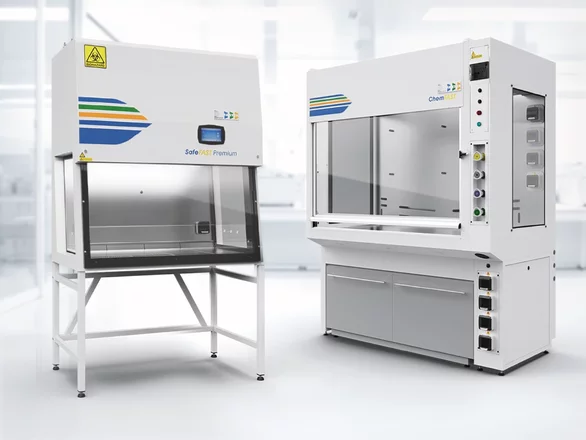
HEPA and ULPA filters are standard in FASTER units: all SafeFAST safety cabinets, GloveFAST isolators, FlowFAST product protection fume cupboards and the Flexible Cleanroom operate with certified HEPA filters of class H14 or higher. This is not a given in the market – but a deliberate quality feature. The following sections explain how HEPA filters work, which classes are suitable for which applications, and why the choice of filter has a direct influence on the achievable cleanroom class.
What is a HEPA filter – and how does it differ from other air filters?
The term ‘filter’ has many meanings in everyday life – from vacuum cleaner bags to air conditioning filters. Air filters constitute a distinct, technically sophisticated category: they do not work like a sieve that traps particles based on their size, but instead utilise three physical separation mechanisms simultaneously. This enables them to remove particles that are far smaller than the gaps between the fibres of the filter medium itself.
Conventional coarse and fine filters (filter classes G1 to F9 according to EN 779 / ISO 16890) are sufficient for domestic appliances and general ventilation systems, but are barely effective at removing submicroscopic particles such as viruses, ultrafine aerosols or nanoparticles. HEPA filters pick up where fine filters leave off: from class H10, with a minimum total efficiency of 85 per cent, up to H14 with 99.995 per cent, whilst ULPA filters achieve up to 99.999995 per cent at U17. This performance makes them indispensable for medical, pharmaceutical and scientific protection applications.
How do HEPA filters work?
The filter medium in a HEPA filter consists of a dense, random network of cellulose, glass fibre or synthetic fibres with a diameter of approximately 1 to 10 micrometres. The fibres are not uniformly aligned – it is precisely this disorder that is crucial to the filtering effect. Depending on the particle size, different mechanisms come into play:
Inertia effect – for large particles from approx. 1 µm
Large particles have greater inertia due to their mass. When the air flow is directed round a filter fibre, large particles cannot follow this curve – they collide directly with the fibre and adhere to it due to adhesive forces. This mechanism becomes more effective the higher the flow velocity and the larger the particles are.
Barrier effect – for medium-sized particles approx. 0.1–1 µm
Smaller particles with lower mass follow the airflow closely around the fibres. If they come within less than half their diameter of a fibre, van der Waals adhesive forces come into play and the particles adhere to the fibre. The blocking effect depends heavily on the fibre density of the filter: the denser the fibre mesh, the more frequently particles come into contact with fibres.
Diffusion effect – for ultrafine particles smaller than 0.1 µm
Particles smaller than 0.1 micrometres are so strongly influenced by collisions with air molecules that they no longer follow a straight trajectory. Their movement resembles Brownian motion – random and undirected. This chaotic trajectory significantly increases the likelihood that the particles will strike the filter fibres and become trapped. The slower the air flow, the more effective this effect is.
The interplay of these three mechanisms explains the characteristic minimum in the separation efficiency for particles between 0.1 and 0.3 micrometres – the so-called MPPS (Most Penetrating Particle Size). It is precisely at this size that neither the inertial effect nor the diffusion effect is optimally effective, and the barrier effect alone is also limited. The EN 1822 standard therefore deliberately classifies HEPA filters based on this MPPS – those that master this most challenging aspect filter all other particle sizes even more effectively.
HEPA filter classes H10 to H14 – filtration efficiency and cleanroom classes
The European standard EN 1822-1 classifies particulate air filters into 17 classes, divided into EPA (E10–E12), HEPA (H13–H14) and ULPA filters (U15–U17). In German-speaking countries, the term ‘HEPA’ is often used informally to refer to classes H10 to H12 as well, although according to EN 1822 these are technically classified as EPA filters. For safety cabinets and GMP cleanrooms, only HEPA H13 or H14 are relevant – lower classes do not meet the regulatory requirements for these applications. The table shows all classes with their filtration efficiency, assigned cleanroom class and typical application:
| Filter class | Total efficiency | Local efficiency | Cleanroom class | Typical application |
|---|---|---|---|---|
| H10 | > 85 % | – | ISO 8 | Pre-filters, air-conditioning systems, general ventilation |
| H11 | > 95 % | – | ISO 8 | Operating theatres, intensive care units |
| H12 | > 99.5 % | – | ISO 7–8 | Cleanrooms ISO 7–8 / GMP C–D |
| H13 | > 99.95 % | > 99.75 % | ISO 6–7 | Class II safety cabinets, ISO 6–7 / GMP C |
| H14 | > 99.995 % | > 99.975 % | ISO 5 | Class II–III safety cabinets, isolators, ISO 5 / GMP A–B |
A specific calculation illustrates the practical significance: a HEPA H12 filter allows 5 out of 1,000 particles to pass through (0.5 per cent penetration). An H14 filter allows only 5 out of 1,000,000 particles to pass through (0.0005 per cent penetration rate). The difference between H12 and H14 is therefore a factor of 1,000 in terms of protective effectiveness. For applications where a single microbe or a single virus particle is enough to contaminate a product or infect a patient, this difference is not merely theoretical – it is crucial.
ULPA filter classes U15 to U17 – for the most stringent cleanroom requirements
ULPA (Ultra Low Penetration Air) filters exceed the performance limits of HEPA H14 filters and are designed for applications where even a 0.005 per cent particle penetration rate would be unacceptable. They are mainly used in semiconductor manufacturing, nanotechnology, precision optics and aerospace engineering – in other words, wherever ISO classes 1 to 4 are required and particles in the nanometre range can irreversibly damage chip structures, optical coatings or sensors.
| Filter class | Total efficiency | Local efficiency | Cleanroom class | Typical application |
|---|---|---|---|---|
| U15 | > 99.9995 % | > 99.9975 % | ISO 4–5 | Semiconductor manufacturing, high-tech optics |
| U16 | > 99.99995 % | > 99.99975 % | ISO 3–4 | Nanotechnology, precision manufacturing |
| U17 | > 99.999995 % | > 99.9999 % | ISO 1–3 | Ultra-high-purity semiconductor manufacturing, aerospace |
HEPA H14 filters are used as standard in pharmaceutical GMP applications and biological safety cabinets – ULPA filters are generally not required here, as GMP Annex 1 and the EN 12469 standards for biological safety cabinets do not specify a higher class. The use of ULPA filters in laboratory equipment would be technically excessive and would increase flow resistance, thereby raising energy consumption and operating costs.
Design and construction of HEPA filters
The filter medium of a HEPA or ULPA filter is formed by folding thin layers of fibres – usually borosilicate glass fibres, synthetic polymer fibres or cellulose blends – into a compact block. The wave-like pleating significantly increases the effective filter area without increasing the installation volume. The filter block is enclosed in a frame made of aluminium sheet, stainless steel or plywood; the seal between the filter medium and the frame is crucial for the overall efficiency.
A critical aspect of high-performance filters is the tightness of the installation: even a HEPA H14 filter medium with a filtration efficiency of 99.995 per cent is of no use if air flows past the sealing surfaces unfiltered. For this reason, EN 12469 stipulates an MSI (Micro-organism Safety Index) test for biological safety cabinets, in which the filter installed within the unit is tested – not just the filter as a single component. FASTER units are factory-tested for MSI compliance in accordance with EN 12469 and supplied with a test certificate.
Special bag-in/bag-out (BIBO) replacement systems are used to ensure safe filter replacement: these allow contaminated filters to be replaced without operating personnel coming into contact with the filter medium. The old filter is sealed directly inside the replacement bag before being removed. FASTER’s safety workbenches and isolators support this procedure.
Filter types in laboratory settings – a comparison of HEPA, ULPA and activated carbon
HEPA H14 in safety cabinets
Class IIbiological safety cabinets (such as the SafeFAST range from FASTER) use HEPA H14 filters exclusively – in both the supply and exhaust air paths. The supply air filter generates the laminar protective airflow over the work area (ISO 5 conditions), whilst the exhaust air filter protects the surrounding area from aerosols originating from the work area. EN 12469 specifies HEPA H14 filters with MSI testing for Class II fume cupboards. Class III fume cupboards (gas-tight cabinets) and BSL-3/4 applications may require dual H14 filters or ULPA U15 filters.
HEPA H14 in isolators
GloveFAST isolators from FASTER are fitted with HEPA H14 filters in both the supply and exhaust air paths. The closed-loop operation of the isolator means that the interior is permanently separated from the surrounding environment – the filter performance provides an additional level of safety here. For Steriletest isolators and Cyto-Pharma isolators handling HPAPIs, filter tightness and regular integrity testing form part of the IQ/OQ qualification documentation.
Activated carbon filters in laboratory fume cupboards
Another type of filter – the activated carbon filter – is used where it is not particles but chemical gases and vapours that need to be removed from the laboratory air. In FASTER’s ChemFAST laboratory fume cupboards, an activated carbon filter can be optionally fitted in addition to the exhaust air system to capture volatile organic compounds (VOCs), acid vapours or solvent vapours during recirculation mode. Activated carbon filters do not have a particle-trapping function – they complement the HEPA filter but do not replace it. Important: For CMR substances covered by TRGS 906, exhaust air must be vented to the outside – activated carbon filters alone are not sufficient in this case.
HEPA filters in the flexible cleanroom and weighing booth
FASTER’s Flexible Cleanroom and Weighing Booth are equipped with HEPA H14 filters, thereby creating ISO 5-equivalent conditions in the work area. In the weighing cabin, the H14-filtered air flows laminarly downwards over the weighing area – particles and dust clouds are immediately drawn downwards out of the breathing zone.
When do filters need to be replaced – and how?
HEPA and ULPA filters do not have a fixed service life in operating hours; instead, they are replaced when pressure drop occurs. As the filter becomes clogged, the flow resistance (differential pressure) increases – as soon as this exceeds a device-specific threshold, the filter must be replaced. FASTER’s safety workbenches continuously monitor the filter pressure and signal when a replacement is due via visual or audible alerts. In GMP environments, filter replacement is a documented maintenance procedure that must be recorded.
Typical filter service lives range from one to five years, depending on operating conditions (particle load, operating hours, ambient air quality). In cleanrooms with low particle ingress, filters can remain in operation for many years – pressure drop monitoring reliably indicates their actual condition. Premature replacement based solely on the calendar, without measuring pressure drop, is generally unnecessary and results in unnecessary costs.
Special regulations apply to the disposal of contaminated filters – following work involving pathogens, cytostatic drugs or radioactive substances. Contaminated filters are classified as hazardous waste and must be packaged, labelled and disposed of accordingly. The bag-in/bag-out procedure, which is supported by FASTER’s equipment, simplifies the safe initial packaging of the contaminated filter without direct operator contact.
Frequently asked questions about cleanrooms
What is the difference between HEPA H13 and HEPA H14?
Both belong to the HEPA filter class in accordance with EN 1822-1, but differ in terms of filtration efficiency: H13 achieves at least 99.95 per cent overall and 99.75 per cent at the worst local point. H14 achieves 99.995 per cent overall and 99.975 per cent locally – that is ten times the level of protection offered by H13. Only H14 is approved for biological safety cabinets in accordance with EN 12469 and for GMP Class A requirements as set out in EU GMP Annex 1. FASTER fits H14 as standard in all its safety cabinets and isolators.
How often do HEPA filters in a safety cabinet need to be replaced?
There is no fixed timeframe – the filter is replaced when pressure drops. FASTER’s SafeFAST workbenches continuously monitor the filter differential pressure and automatically signal when replacement is required. Depending on operating conditions, filters typically last between 1 and 5 years. In GMP environments, filter changes must be documented and form part of the equipment maintenance schedule.
Can HEPA filters be washed and reused?
This depends on the filter material. Filters made from washable synthetic material can be cleaned under certain conditions – however, the filter medium generally loses some of its filtration efficiency in the process, and re-certification as H13/H14 would need to be reassessed after washing. In GMP environments and in the case of contaminated filters, washing is not permitted for safety and qualification reasons. FASTER recommends replacement with tested, genuine replacement filters.
What is the MPPS value – and why is it used to evaluate filters?
MPPS stands for Most Penetrating Particle Size – the particle size at which a filter’s efficiency is at its lowest. For HEPA and ULPA filters, the MPPS typically lies between 0.12 and 0.25 micrometres. Larger and smaller particles are more effectively captured due to the physical capture mechanisms (inertia, barrier effect, diffusion). EN 1822-1 deliberately classifies filters according to their efficiency at the MPPS: if a filter meets the class requirement for the most challenging particle size, it automatically meets it for all other sizes as well.
Which filter do I need for my fume cupboard – HEPA or ULPA?
For biological safety cabinets in accordance with EN 12469 (Classes I, II, III), HEPA H14 is the prescribed standard. ULPA filters (U15–U17) are generally not required for laboratory fume cupboards and increase airflow resistance, which in turn increases energy consumption. ULPA filters are primarily used in semiconductor manufacturing and nanotechnology (ISO 1–4). All SafeFAST fume cupboards from FASTER are fitted as standard with HEPA H14 filters and an MSI test certificate in accordance with EN 12469.
What is an activated carbon filter – and can it replace a HEPA filter?
No – activated carbon filters and HEPA filters serve completely different purposes. Activated carbon filters adsorb chemical gases and vapours (VOCs, acids, solvents), but have no significant particle-removal capability. HEPA filters remove particles, aerosols, viruses and bacteria, but are ineffective against gaseous pollutants. In recirculating laboratory fume cupboards, both are combined – the HEPA filter for particles and the activated carbon filter for gases. FASTER’s ChemFAST laboratory fume cupboards offer this combination as an option.
