
Information
Cleanroom
A cleanroom – also known as a ‘clean space’ at the highest purity level – is an enclosed, monitored area in which the concentration of airborne particles and germs is maintained permanently below defined limits. It is not an ordinary laboratory, but rather a technical system comprising air flow, filtration, pressure control, monitoring and staff protocols, which together create a controlled environment. Where normal ambient air is unsuitable for highly sensitive processes – in pharmaceutical production, semiconductor manufacturing, medical technology or cell therapy – the cleanroom is the only alternative.
The requirements for a cleanroom are governed by international standards: ISO 14644-1 classifies cleanrooms into nine classes (ISO 1 to ISO 9) based on particle concentration, whilst the EU GMP Guidelines Annex 1 defines four classes (A to D) for pharmaceutical production, with additional microbiological limit values. FASTER offers a complete range of cleanroom technology and equipment: from flexible cleanrooms, isolators and safety cabinets to H₂O₂ airlocks and particle measurement systems.
What is a cleanroom – and when is one required?
The ISO 14644-1 standard defines a cleanroom as “a room in which the concentration of airborne particles is controlled and which is constructed and operated in such a way as to minimise the introduction, generation and retention of particles within the room”. This technical definition may sound abstract, but it has a very concrete implication: a cleanroom is not simply a particularly clean version of a normal room, but an entirely different system. Depending on the environment, normal indoor air contains between 500,000 and several million particles per cubic metre. An ISO Class 5 cleanroom permits a maximum of 3,520 particles ≥ 0.5 µm – a reduction by a factor of 100 to 1,000.
A cleanroom is always necessary whenever normal ambient air jeopardises the quality, safety or function of a product or process. In the manufacture of sterile medicines, a single particle or microbe in the product can lead to life-threatening contamination. In semiconductor manufacturing, dust particles smaller than 0.1 µm can destroy structures on the chip. In cell therapy and gene therapy, any contamination jeopardises efficacy – and, in the worst-case scenario, the patient’s life.
How does a cleanroom work? The four principles of protection
A cleanroom does not achieve its cleanliness requirements through a single measure, but through the interplay of four principles of protection, all of which must be effective simultaneously.
1. Air filtration and air exchange
At the heart of every cleanroom is the air distribution system. Supply air is filtered through HEPA or ULPA (High Efficiency Particulate Air / Ultra Low Penetration Air) filters before it flows into the room. HEPA H14 filters capture 99.995 per cent of all particles ≥ 0.3 µm, whilst ULPA filters capture as much as 99.9995 per cent. The air change rate – that is, how often the entire volume of air in the room is replaced per hour – is crucial for achieving the required cleanroom class: Whilst an ISO 8 room requires 20–60 air changes per hour, an ISO 5 area requires air change rates of 240–600 per hour with laminar flow.
2. Pressure control
Air pressure in a cleanroom is not a secondary factor, but an active protective measure. Cleanrooms designed to protect products or the surrounding environment (e.g. pharmaceutical production) are operated at positive pressure relative to adjacent areas: Air always flows from the cleaner zone to the less clean zone, so that no contaminated air can enter. Conversely, in areas where hazardous substances or pathogens are handled (BSL laboratories, containment areas): Here, negative pressure ensures that no contaminated air escapes to the outside. The pressure differential between adjacent cleanroom zones is typically 10–15 pascals.
3. Staff protocols and airlocks
People are the largest source of particles in a cleanroom. A person at rest emits around 100,000 particles per minute; when moving, this figure rises to up to one million. Cleanroom staff must therefore adhere to specific entry procedures, the strictness of which varies depending on the cleanroom class. For lower classes, wearing hairnets and shoe covers is sufficient. For GMP Classes A and B, full cleanroom suits, double gloves, masks and structured donning protocols are mandatory. Personnel air showers remove particles from protective clothing using high-velocity jets of air as staff enter the cleanroom – before they step inside. FASTER’s air showers are available for all cleanroom classes.
4. Material airlocks and surface cleanliness
Any item brought into a cleanroom is a potential carrier of particles and germs. Materials, tools, packaging and machinery must be cleaned before being brought in and – in GMP Class A/B areas – disinfected. FASTER’s H₂O₂ airlock enables validatable, sporicidal decontamination of materials upon entry: hydrogen peroxide vapour (NHP process) reaches all surfaces, leaves no residues and is fully documentable in accordance with GMP Annex 1.
Principles of airflow in cleanrooms – laminar or turbulent?
The airflow within a cleanroom determines how effectively particles are removed from the work area. There are essentially two principles, which are used depending on the required cleanroom class:
| Flow principle | Operating principle | Cleanroom class | Special features / FASTER reference |
|---|---|---|---|
| Turbulent dilution flow (TAV) | Filtered air is blown in turbulently; Particles are diluted, not displaced | ISO 6–8 / GMP C–D | Cost-effective design; suitable for less critical areas; higher energy consumption at high air change rates |
| Laminar displacement flow (LAF / unidirectional) | Uniform, unidirectional air flow physically displaces particles from the work area | ISO 1–5 / GMP A–B | Lowest level of contamination; mandatory for aseptic processes; Basis for safety cabinets & isolators |
| Hybrid forms / zoned systems | Combination: laminar zone (e.g. safety cabinet/isolator) in a turbulent airflow environment | ISO 5 locally + ISO 7–8 environment | Standard in GMP pharmaceuticals: Class A isolator in a Class C background room |
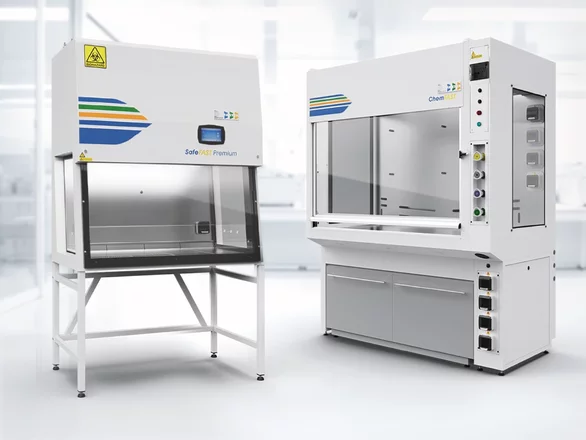
In pharmaceutical practice, the combination of both principles is standard: A GloveFAST isolator or a SafeFAST safety cabinet creates localised laminar ISO 5 conditions (GMP Class A), whilst being situated within an ISO 7 background room with turbulent airflow (GMP Class C). This zoned approach is technically more efficient and cost-effective than operating an entire room to ISO-5 standard.
Applications of cleanrooms – which industries require cleanroom conditions?
Cleanrooms are an indispensable component wherever particles, germs or uncontrolled environmental influences jeopardise product quality or process reliability. Pharmaceutical manufacturing facilities that produce sterile medicines, biologics, vaccines or gene therapy products are subject to by far the most stringent requirements. Here, GMP Annex 1 Classes A to D are mandatory, and any deviations can lead directly to regulatory action, product recalls and production halts.
In semiconductor manufacturing and microsystems technology, by far the strictest particle requirements of all apply – ISO 1 to ISO 3 – as contamination from nanometre-sized particles can cause irreversible damage to functional structures on chips and sensors. The aerospace, optics and photonics sectors, as well as precision engineering, primarily use cleanrooms for manufacturing and testing processes. In modern biotechnology and cell therapy, particularly in the manufacture of CAR-T cells, mRNA vaccines and AAV vectors, GMP cleanrooms with aseptic isolators are the operational standard.
- Pharmaceutical production (GMP Annex 1): sterile medicinal products, biologics, vaccines, blood products, ophthalmic products – Classes A to D
- Biotechnology & cell therapy: CAR-T cells , mRNA, AAV vectors, stem cells – GMP isolators and aseptic workbenches
- Medical devices (ISO 13485): Implants , catheters, diagnostic devices – ISO 7/8 cleanrooms with particle monitoring
- Semiconductor manufacturing: chips , sensors, MEMS – ISO 1–3 with laminar ceiling airflow and ULPA filtration
- IVF & reproductive medicine: Laboratories for oocytes, sperm and embryos – VOC-free cleanroom workbenches
- Food & Beverages (HACCP): Aseptic filling, cleanroom packaging – ISO 7/8 with air showers
- Optics, photonics & precision mechanics: lenses , mirrors, lasers – ISO 5–7 for contamination-free assembly
Planning a cleanroom – what are the key considerations?
Planning a cleanroom does not begin with the technology, but with the process: Which cleanroom class is required for the planned operation? What are the contamination risks? Are there any GMP requirements that go beyond mere particle classification? Only once these questions have been answered can the technical design – air change rate, airflow pattern, pressure regime, filter concept, airlock concept – be properly defined.
For pharmaceutical companies, the decision between an open Class A/B zone and an isolator system is one of the most important strategic planning considerations: whilst an isolator involves a higher initial investment than an open zone, it reduces the requirements for the background room to GMP C, thereby delivering significant long-term savings in terms of operation, qualification and staffing costs. FASTER provides advice on this decision based on the specific process requirements, the existing room layout and regulatory requirements.
Frequently asked questions about cleanrooms
What is a cleanroom and what is it used for?
A cleanroom is a controlled environment in which the concentration of airborne particles and microorganisms is maintained at levels consistently below defined limits. It is used wherever normal ambient air could pose a risk to products, processes or patients: in pharmaceutical production (sterile medicines), semiconductor manufacturing (chips), medical technology (implants), cell therapy and aerospace engineering.
How much does a cleanroom cost – and are there any cost-effective alternatives?
A conventionally built GMP cleanroom (Class C/D) costs between 50,000 and several million euros, depending on its size and fittings. A significantly more cost-effective alternative is the Flexible Cleanroom from FASTER: It is installed within existing rooms, requires no building alterations and meets ISO 7/8 requirements (GMP C/D) at a fraction of the cost. For Class A requirements, isolators offer a more cost-effective solution than fully fitted Class A/B rooms.
What is the difference between negative and positive pressure in a cleanroom?
Positive pressure prevents contaminated air from entering the cleanroom from outside – a standard requirement for product protection (pharmaceutical production, semiconductors). Air always flows from the cleaner zone to the less clean zone. Negative pressure prevents hazardous substances or pathogens from escaping to the outside – a standard requirement for personal protection in BSL laboratories, containment areas or when handling cytostatic drugs. The pressure differential between adjacent zones is typically 10–15 pascals.
What cleanroom class do I need for the manufacture of sterile medicinal products?
EU GMP Annex 1 stipulates the following for the aseptic manufacture of sterile medicinal products: Class A (ISO 5) for the critical work area (filling port, aseptic connections), Class B as the background environment for open aseptic processes, Class C for less critical steps (e.g. solution preparation prior to sterile filtration), Class D for non-critical preparation steps. Where a validated isolator is used, the background environment may be reduced to Class C.
How often does a cleanroom need to be cleaned and disinfected?
The frequency depends on the cleanroom class and the hygiene plan. In GMP Class A/B, daily surface disinfection with documented rotation of active ingredients is standard practice; periodic room disinfection (e.g. H₂O₂ decontamination) supplements the routine measures. In Class C/D, weekly cycles are standard. GMP Annex 1 requires regular alternation between at least two active agents with different spectra of activity, including a sporicidal agent. FASTER provides support for H₂O₂ room disinfection as a service and with suitable airlock technology.
What does FASTER offer in terms of cleanroom planning and equipment?
FASTER offers a comprehensive range of cleanroom technology: flexible cleanrooms (ISO 7/8), personnel air showers, H₂O₂ airlocks, weighing booths, SafeFAST safety workbenches (ISO 5 / GMP A), GloveFAST isolators (GMP A with background class C possible), particle counters and IQ/OQ qualification documentation. In addition, FASTER offers bespoke cleanroom design and consultancy on compliance with ISO 14644-1 and GMP Annex 1.
