
Information
Biological safety cabinet
A biological safety cabinet protects users, samples and the laboratory environment from contamination by aerosols, spores and infectious particles during genetic engineering and microbiological work. FASTER develops and manufactures biological safety cabinets in accordance with international standards (EN 12469, DIN EN ISO 14644) – ranging from compact single-workstation solution to fully enclosed Class III systems.
Discover biological safety cabinets
What is a biological safety cabinet and what is it used for?
A biological safety cabinet (also known as a sterile bench, sterile chamber, safety cabinet, flow cabinet or laminar flow cabinet) is a specially designed laboratory workstation that creates controlled, particle-free working conditions through an integrated air filtration system. It is used wherever protection against biological hazards – such as microorganisms, viruses, cell cultures or recombinant DNA molecules – is required.
At the heart of every biological safety cabinet is a HEPA or ULPA filter which, in conjunction with a vertical, laminar air flow, ensures a contamination-free working environment in accordance with ISO Class 5 (equivalent to EU GMP Class A).
How does a biological safety cabinet differ from a laboratory fume cupboard?
This is one of the most frequently asked questions in day-to-day laboratory work. The key difference lies in the principle of protection:
- Biological safety cabinets filter particles and aerosols using HEPA/ULPA filters. They do not provide protection against hazardous substances in the form of gases or vapours.
- Laboratory fume cupboards, on the other hand, are specifically designed for chemical vapours and gases. They do not provide adequate protection against biological aerosols.
- Cleanroom workbenches provide product protection exclusively through clean supply air – the user is not protected.
When working with biological hazards, a certified biological safety cabinet of the appropriate protection class must therefore always be used.
What are the different safety classes for biological safety cabinets?
Biological safety cabinets are divided into three protection classes in accordance with EN 12469, which differ in terms of protection level, airflow and scope of application. The following table provides a quick overview:
| Classes | Personal protection | Product protection | Environmental protection | Typical applications |
|---|---|---|---|---|
| Class I | Yes | No | (Yes) | Open-air applications, older laboratories |
| Class II | Yes | Yes | Yes | Microbiology, pharmaceuticals, diagnostics |
| Class II B2 | Yes | Yes | Yes | Volatile chemicals, cytostatic drugs |
| Class III | Yes | Yes | Yes | BSL-3/4, high-security laboratories |
Principles and areas of application of Class I biological safety cabinets
The Class I safety cabinet has an open front. Ambient air is drawn in through the working opening, across the work surface, and directed to a HEPA filter, which traps aerosols and particles. Part of the filtered air is recirculated into the room. Class I provides personal protection only – arms and hands inside the work area are not protected. There is no product protection. Class I fume cupboards are now mainly used in existing, older installations or for specific applications.
Applications of Class II biological safety cabinets
Class II fume cupboards are the industry standard in modern laboratory and pharmaceutical environments. The front panel is only partially open. A vertical, laminar air flow directs part of the air to extraction vents at the edge of the work surface; the other part is filtered and directed over the workpiece as clean supply air. Sensors monitor the air flow and trigger an alarm in the event of a fault.
Class II protects both the user (provided sufficient air is extracted) and the workpiece from contamination. Arms and legs remain unprotected with this class.
Special case: Class II Type B2: This variant vents 100 per cent of the exhaust air to the outside. It is therefore suitable for applications involving volatile chemical substances or cytostatic drugs.
Applications for Class III biological safety cabinets
Class III workbenches (also known as glove boxes) are fully enclosed systems that operate under negative pressure. Access to the interior is exclusively via permanently fitted gloves and pass-through chambers. Inlet and exhaust air are filtered, and the constant negative pressure prevents contaminated air from escaping, even in the event of seal failures. Class III offers the highest level of protection available and is used for work with BSL-3 and BSL-4 pathogens, highly hazardous pathogens, and in aseptic production.
Applicable standards and certifications for biological safety cabinets
The use of biological safety cabinets is strictly regulated. The most important applicable standards and regulations are:
- European standard: EN 12469
Mandatory standard for microbiological safety cabinets in Europe. Specifies requirements for design, airflow, filters and test methods. - US standard: NSF/ANSI 49
The authoritative standard for biological safety cabinets in North America – relevant for manufacturers exporting internationally. - Cleanroom class ISO 5: DIN EN ISO 14644-1
Class II fume cupboards meet the requirements of cleanroom class ISO 5 in the working area, corresponding to EU GMP Class A. - Pharmaceutical GMP requirements: EU GMP Guidelines Annex 1 (2022)
Mandatory requirements for aseptic manufacturing processes in the pharmaceutical industry. FASTER workbenches are designed for GMP compliance.
Important: Biological safety cabinets must be validated and certified by accredited experts following installation, after relocation and at regular intervals. FASTER offers its own validation and maintenance service for this purpose.
You can reach us for consultation at
+49 (0) 7641-468819-0
Features and available accessories for biological safety cabinets
Biological safety cabinets are modular in design to allow flexible adaptation to different laboratory requirements. The interior is made of stainless steel (AISI 304 or 316) with rounded corners, which facilitates easy cleaning and decontamination.
Standard features of the FASTER SafeFAST:
- Stainless steel interior (removable for cleaning)
- Touch control panel with status display and alarm system
- Energy-efficient LED lighting
- Low-vibration and low-noise fan technology
- Height-adjustable front pane made of safety glass
Optional extras:
- Electrical sockets, gas, vacuum and media connections (IP66)
- H₂O₂ decontamination system (NHP technology) for validatable inactivation
- IV hanging rails and hooks for pharmaceutical bag applications
- External display connection (HMI, touchscreen, remote access)
- Integration of microscopes, balances or centrifuges
- Base frames, ergonomic footrests, laboratory chairs
Which models of biological safety cabinets does FASTER offer?
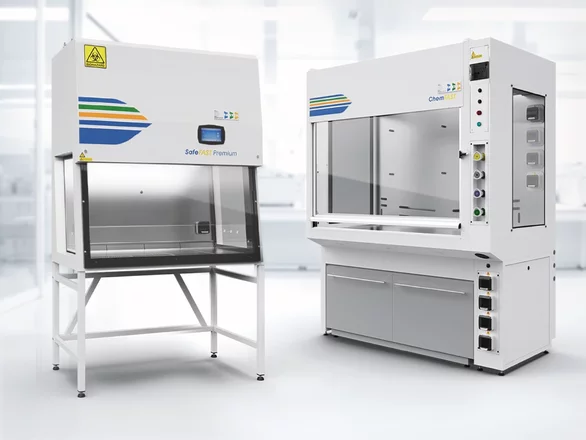
FASTER offers a comprehensive range of biological safety cabinets for all safety classes and areas of application. All models in the SafeFAST range are available at short notice and can be customised.
In which industries and laboratory settings are biological safety cabinets used?
FASTER’s SafeFAST range covers a wide spectrum of applications:
- Microbiological and molecular biology research (universities, research institutes)
- Pharmaceutical development and quality control (GMP laboratories, active ingredient production)
- Biotechnology production laboratories (cell culture, fermentation, upstream/downstream)
- Clinical diagnostics and pathology (hospital laboratories, medical care centres, pathology departments)
- Hospital pharmacies and oncology centres (preparation of cytostatic drugs)
- Public health institutions and testing laboratories (RKI, veterinary authorities, environmental laboratories)
- IVF and reproductive medicine (specialised workbenches for embryonic cells)
Frequently asked questions about biological safety cabinets
What is the difference between a biological safety cabinet and a laboratory fume cupboard?
Biological safety cabinets are specifically designed to protect the user, the environment and the product from biological hazards. They use highly effective HEPA or ULPA filters, which reliably remove particles and aerosols such as bacteria, viruses or fungal spores from the air. This creates a defined, sterile working area.
A standard laboratory fume cupboard, on the other hand, is primarily intended to provide protection against chemical vapours and gaseous substances. It extracts these substances from the work area in a controlled manner but does not offer sufficient protection against biological contamination. Laboratory fume cupboards are therefore not suitable for microbiological work or the handling of pathogens.
What protection class do I need for my laboratory application?
The choice of the correct protection class depends on the nature of the activity and the specific risk involved. Class I is used for work where product protection is not required and the focus is on personal protection.
Class II is the most commonly used variant and is suitable for the majority of microbiological, biotechnological and cell culture applications, as it ensures the protection of personnel, products and the environment.
Class III is used for particularly hazardous pathogens, especially in high-security laboratories at containment levels BSL-3 and BSL-4. These systems provide a fully enclosed working environment.
Class II B2 is used when working with volatile chemicals, cytostatic agents or similar substances, as all exhaust air is discharged to the outside. The selection is always based on a careful risk assessment in accordance with the BioStoffV.
How often does a biological safety cabinet need to be serviced and validated?
To ensure safe operation in the long term, biological safety cabinets must be inspected at least once a year by qualified specialist staff and validated in accordance with the EN 12469 standard. This involves checking, amongst other things, airflows, filter performance and airtightness.
Furthermore, a re-inspection is required if the workbench has been repositioned, a filter has been replaced or technical repairs have been carried out. This is the only way to ensure that the protective function remains fully intact at all times. Many manufacturers, including FASTER, offer specialised maintenance and validation services for this purpose.
Are FASTER safety workbenches GMP-compliant?
Yes, the safety cabinets in the FASTER SafeFAST series are designed to consistently meet the requirements of the GMP guidelines. In particular, they comply with the specifications of EU GMP Annex 1 (2022), which governs sterile manufacturing processes.
The working area achieves ISO Class 5 cleanroom standard (equivalent to EU GMP Class A) as standard, meeting the most stringent requirements for particle and microbial freedom. On request, FASTER provides comprehensive documentation, including IQ/OQ/PQ qualification and Factory Acceptance Tests (FAT), to support validation in a regulated environment.
What does ‘Type B2’ mean in the context of a Class II biological safety cabinet?
A Class II safety cabinet of the B2 type differs significantly from other variants in terms of its exhaust air system. Whilst in Type A some of the air remains in circulation, in Type B2 100 per cent of the exhaust air is extracted from the work area to the outside.
This principle is particularly necessary when working with volatile chemical substances, cytostatic drugs or radioactively labelled substances. This prevents potentially hazardous vapours from returning to the work area or being released into the surrounding environment.
